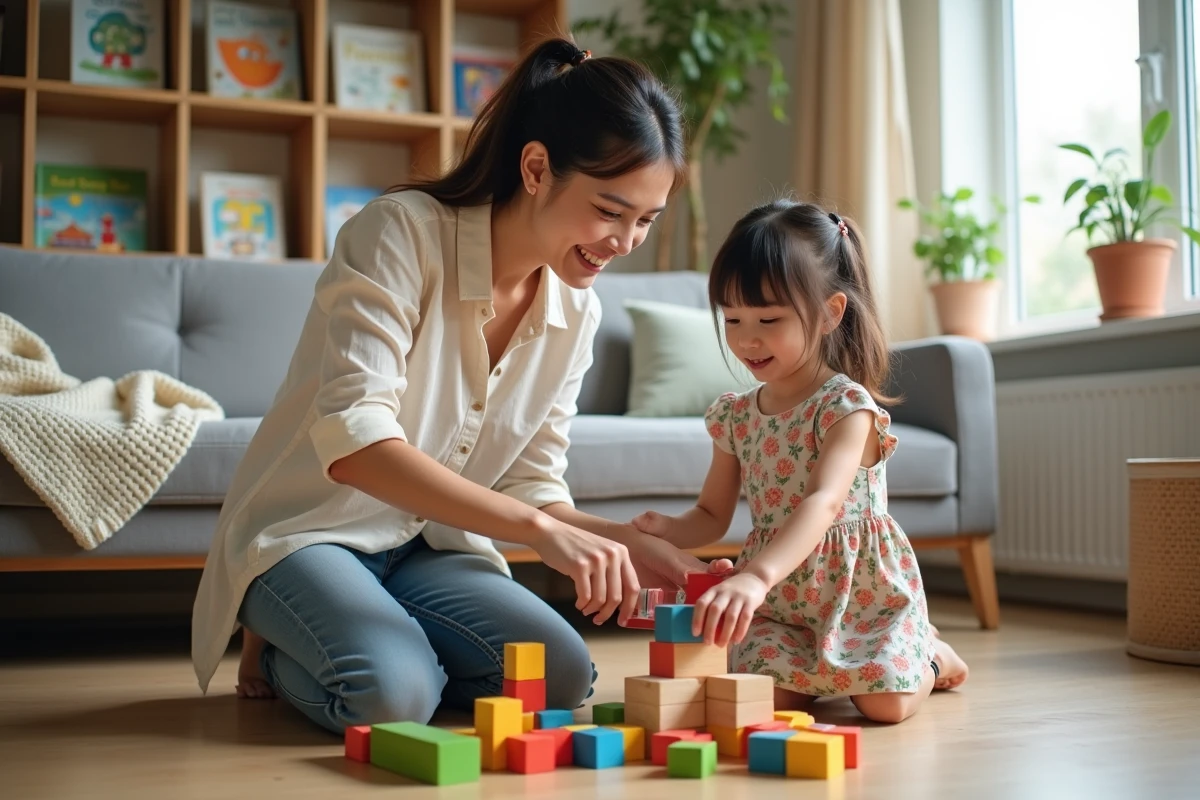
A child who wakes up in a good mood, who rushes off to play without hesitation, who asks questions about everything: these everyday signals reflect a concrete flourishing. Supporting this process does not require a sophisticated program, but rather regular adjustments in family life, including on the parents’ side.
Parents’ Mental Health and Children’s Daily Flourishing
Have you ever noticed that after a short night, your patience dwindles in just a few minutes? It’s not a coincidence. Recent research in developmental psychology shows that the parent’s ability to regulate their own stress is one of the best predictors of the child’s flourishing, even more than the total time spent with them. Since 2023, the Haute Autorité de Santé has emphasized the importance of supporting parental mental health in preventing children’s emotional difficulties.
Specifically, an exhausted parent reacts more quickly, listens less, and tolerates conflicts between siblings poorly. The child picks up on this tension and adjusts their behavior: they may withdraw or, conversely, test boundaries more.
Taking care of oneself is not a luxury reserved for child-free weekends. It involves simple gestures:
- Protecting your sleep by postponing non-urgent household tasks rather than cutting into your rest hours
- Identifying a short physical activity (walking, stretching) that can be done even with a child present in the room
- Seeking help (partner, grandparents, neighbors) without waiting until you are on the brink of breaking down
Several parents sharing their experiences on the child resources of Le Petit Blog de Maman describe this cascading effect: when mental load decreases, family interactions improve in quality without additional effort.

Involving the Child in Concrete Family Decisions
Letting a child choose between two activities on Wednesday afternoons may seem trivial. The effect on their self-confidence is not. The ELFE study (French Longitudinal Study from Childhood, Inserm/INED, report 2023) links a child’s involvement in concrete family decisions to better self-esteem and fewer anxiety disorders, particularly among 8-12 year-olds.
Giving real decision-making power, even if limited, changes the child’s posture. They move from being a spectator to an actor in their daily life. This autonomy has nothing to do with letting them do whatever they want.
Adapting the Level of Responsibility to Age
At around 4-5 years old, offering two options is enough: “Shall we go to the park or do some painting?” The child learns to formulate a choice and take responsibility for it.
At around 8-10 years old, the stakes can rise. Participating in organizing a meal, managing a small budget for an outing, deciding on the layout of their room. Each responsibility entrusted builds a specific skill.
A common pitfall: offering a false choice. “Do you want to tidy your room now or now?” fools no one. A real choice means that both options are acceptable to the parent.
Family Screen Time: The Difference Between Subdued Time and Shared Time
The debate about screens often revolves around the number of allowed minutes. This approach misses a documented distinction. A joint report from the Défenseur des droits and the CNIL (2023) on digital usage among 0-14 year-olds shows that screen time shared with a parent is associated with better language and social skills, while subdued screen time (child alone in front of the screen) is linked to more isolation behaviors.
Watching a wildlife documentary together while commenting on what we see does not have the same effect as placing a tablet on the restaurant table to buy silence. The determining variable is not the duration; it’s the active presence of the adult.
Two Concrete Guidelines for Daily Life
Before turning on a screen, ask yourself a simple question: will I be available to watch with my child for at least part of the time? If the answer is no, suggesting a screen-free independent activity (drawing, building, free play) is still preferable.
Naming what we see on the screen transforms passive time into learning. “Look how the bird builds its nest” sparks a conversation. The child asks questions, makes connections, and develops their vocabulary.
Montessori Education at Home: What Works Without Specific Materials
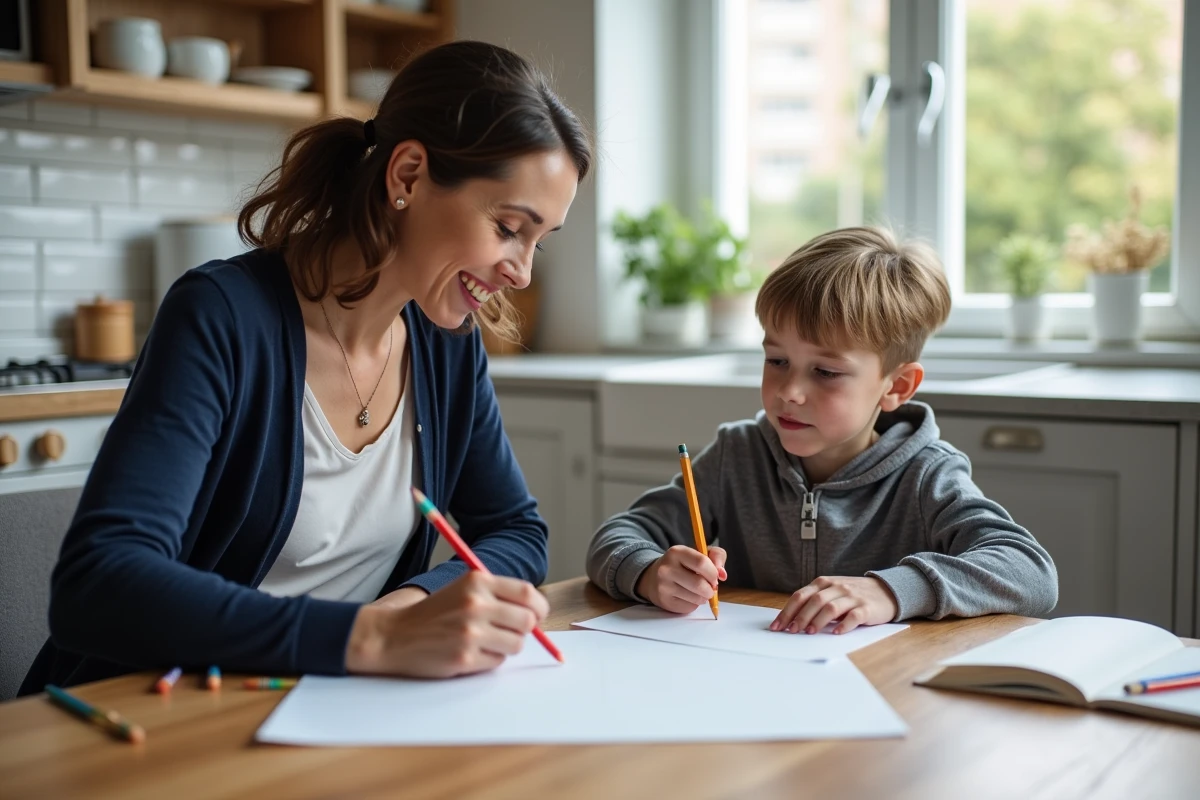
Montessori education is not just about wooden shelves and sorting trays. The central principle can be summed up in one sentence: adapt the environment so that the child can do it alone. At home, this translates into practical adjustments that cost nothing.
A stable step stool in the kitchen allows a three-year-old to wash their hands independently. A coat rack fixed at their height gives them access to their coat. These details may seem minor, but they eliminate dozens of daily micro-requests that generate frustration on both sides.
Learning from Mistakes
When a child spills water next to the glass, the most productive reaction is neither to scold them nor to do it for them. Showing them where the sponge is teaches them to correct it themselves. This loop (try, fail, fix) builds lasting confidence in their ability to act.
Supporting without doing it for them requires more patience than expertise. This is where managing parental stress directly intersects with pedagogy: a rested parent more easily allows their child to fumble.
A child’s flourishing is built in the back-and-forth between their growing autonomy and their parents’ emotional availability. Adjusting your own pace, entrusting real responsibilities, sharing screen moments, arranging the space: none of these actions require a degree in pedagogy, just regular attention to what works and what doesn’t.