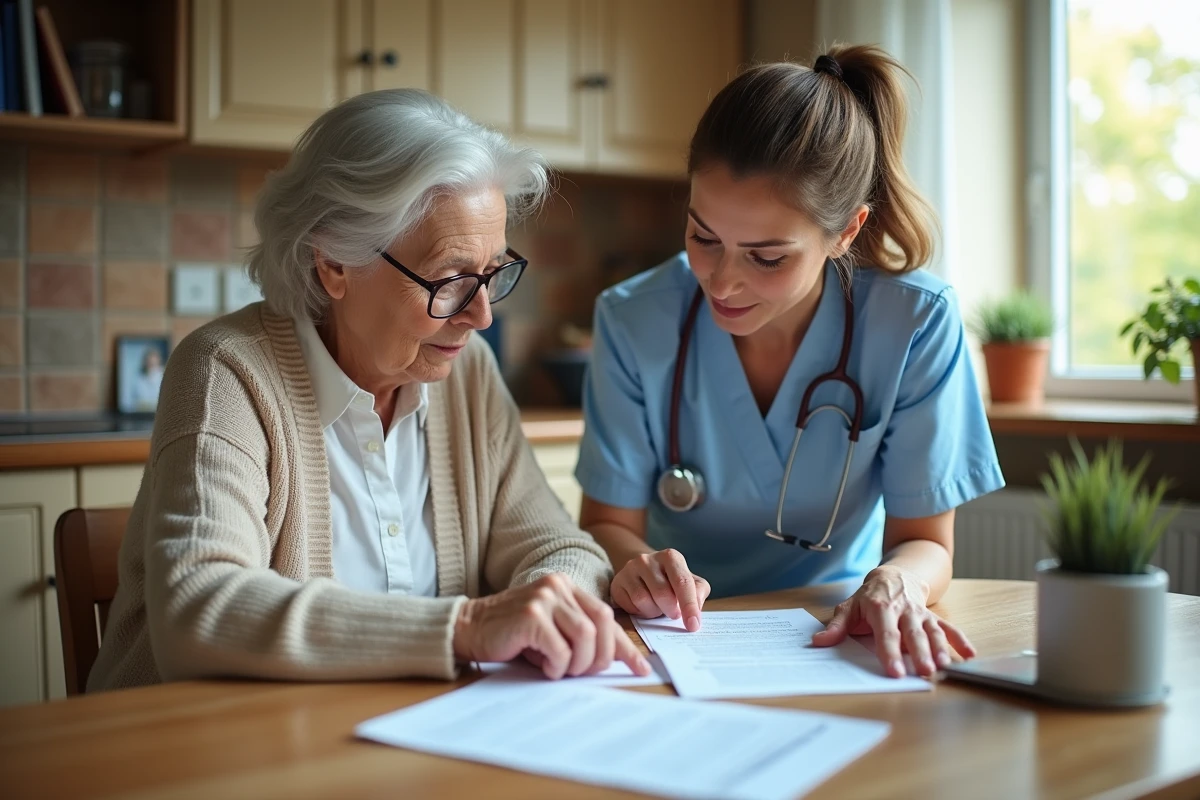
The relationship between APA, housing assistance, and home services remains poorly understood by most families. The rate of non-utilization of rights among the elderly confirms a structural problem: the systems exist, but their access remains fragmented. We review the most effective mechanisms for staying at home, emphasizing the points of caution that general guides do not address.
MaPrimeAdapt’ and tax credit for autonomy: non-cumulative rules to know
Since 2024, MaPrimeAdapt’ has become the reference aid for adapting the housing of seniors with loss of autonomy. Managed by Anah, it covers a significant portion of the work (up to 50 to 70% within a ceiling of 22,000 euros excluding tax depending on the income profile). Obtaining it requires the use of a project management assistant (AMO) for technical diagnosis and file preparation.
The most common trap concerns the coordination with the so-called “autonomy” tax credit, intended for safety equipment such as grab bars or shower seats. These two systems cannot be combined for the same work. We recommend having the choice arbitrated in advance by the AMO, as the optimal financial arrangement depends on the actual remaining charge after MaPrimeAdapt’.
Specifically, for a bathroom to be adapted, the most effective sequence is to request MaPrimeAdapt’ as a priority, then reserve the autonomy tax credit for complementary equipment not covered. Reversing this order or submitting both requests in parallel for the same work item risks partial rejection.
To better understand how these mechanisms interlock with all available allowances, it is useful to consult the aid systems on Senior Surfers that detail each aspect of the administrative process.
APA at home: what the aid plan does not finance
The personalized autonomy allowance remains the foundation for staying at home for people classified as GIR 1 to 4. The aid plan, developed after evaluation by the departmental medico-social team, sets a monthly ceiling based on the degree of loss of autonomy.
What popular articles often overlook is the list of what the APA does not cover:
- Heavy adaptation work on housing (falling under MaPrimeAdapt’ or retirement fund grants, not APA)
- Meal delivery costs beyond the reference rate set by the department, with the remaining charge varying significantly from one area to another
- Teleassistance devices in certain departments that exclude them from the aid plan or cap them at a symbolic amount
- Home help hours that exceed the GIR ceiling, even if the actual need justifies them
Exceeding the aid plan remains fully the responsibility of the individual or their family. This data changes the situation for GIR 3 and 4, whose ceilings are lower: families must anticipate co-financing, either through complementary retirement funds or from their own resources.
Complementary retirement funds: an underutilized resource
The Agirc-Arrco funds offer one-time or recurring assistance for retirees classified as GIR 5 and 6 (autonomous but fragile) who are not eligible for the APA. These aids finance hours of housekeeping help, meal delivery, or preventive assessments.
For GIR 1 to 4, they can intervene in addition to the APA for uncovered items. We observe that less than a third of potential beneficiaries request this complementary assistance, often due to a lack of knowledge about the application process, which is distinct from that of the department.
Single territorial gateway: what changes for access to rights
The ongoing reorganization of information circuits aims to create a single entry point by territory. The stated goal is to reduce the renunciation of rights, a massive phenomenon among isolated elderly people and their caregivers.
In practice, this convergence means that CLICs (local information and coordination centers), MAIA, and departmental services are gradually merging their databases and physical offices. For families, this translates into a single contact person capable of simultaneously directing them to the APA, MaPrimeAdapt’, home help services (SAAD), and respite care systems for caregivers.

Respite for caregivers: day care and temporary accommodation
Respite solutions remain the poor relation of the system. Day care in specialized facilities allows the elderly person to maintain a supervised social connection while freeing the primary caregiver for a few hours each week. Temporary accommodation in nursing homes or assisted living can be partially financed by the APA, provided that the aid plan has been revised in advance.
The right to respite, enshrined in the law adapting society to aging, provides for a specific annual ceiling that can be mobilized when the APA ceiling of the aid plan is reached. This mechanism remains little activated, due to a lack of available places and clarity in the administrative process.
Teleassistance and connected objects: beyond the classic pendant
Teleassistance has long been reduced to the alert pendant worn around the neck. Current systems integrate motion sensors, automatic fall detectors, and geolocation solutions for people with cognitive impairments.
Funding varies by department. Some include it in the APA aid plan, others offer a separate flat-rate aid, while others refer to retirement funds. Checking local coverage before subscribing to a service avoids unnecessary costs.
Connected objects (smart pill dispensers, automatic light paths, activity sensors) do not yet benefit from a unified funding framework. Their acquisition generally falls under the autonomy tax credit or one-time assistance from complementary funds, depending on the nature of the equipment.
Staying at home relies on a combination of systems, none of which, taken in isolation, cover all needs. The main difficulty remains the sequencing of requests and coordination among funders. Going through the future single territorial gateway, when operational in its area, remains today the most direct way to avoid duplications and omissions of rights.