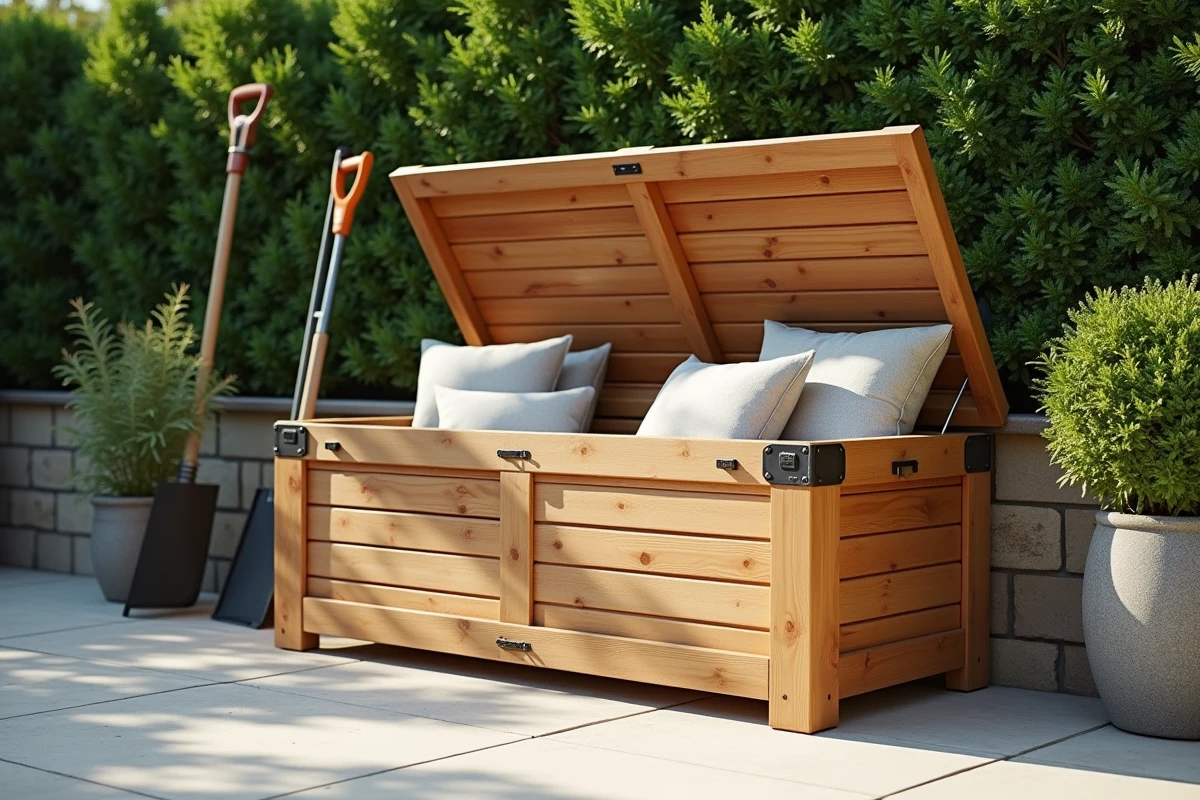
The garden chest occupies a unique place in the outdoor storage market. Neither a garden shed nor a simple storage box, it lies at the intersection of furniture and utility. In large DIY stores, the offering has significantly expanded in recent years, with models that no longer limit themselves to raw storage but incorporate seating functions, recycled materials, and sizes designed for small urban spaces.
Resin, wood, metal: how the material changes daily use
Most outdoor storage guides list materials without explaining their concrete implications in use. The choice between resin, wood, and metal is not just an aesthetic question. It affects maintenance, weather resistance, and the actual lifespan of the chest.
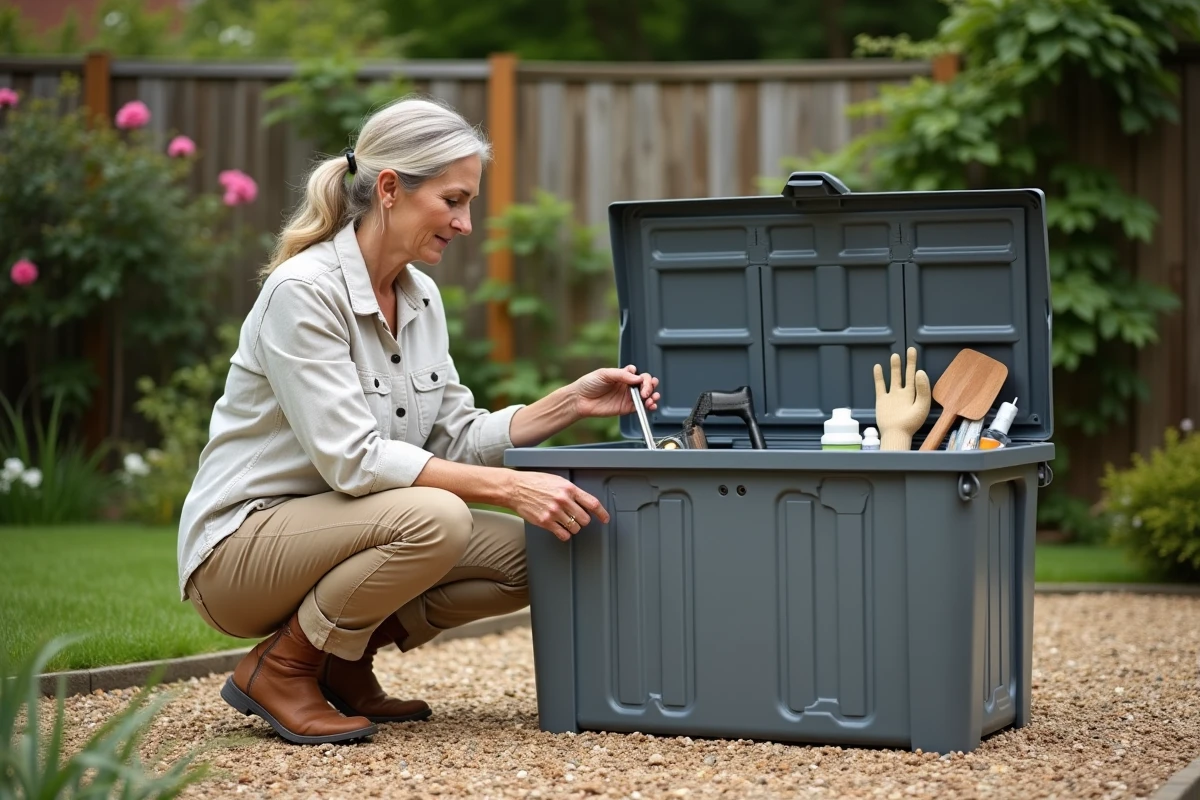
Resin (polypropylene or PVC) dominates the segment of chests sold in DIY stores. Manufacturers positioned in this niche increasingly highlight recycled or partially recycled resins, BPA-free, in a logic of eco-design. This point deserves attention: a chest made of recycled resin does not necessarily weigh less, but it generally withstands UV rays and hinge corrosion well, two factors of rapid degradation outdoors.
Wood (treated pine, acacia) offers a warmer appearance but requires regular treatment against moisture. Without stain or saturator applied each year, graying sets in within a few seasons. Aluminum, rarer in this price range, has the advantage of being lightweight and naturally resistant to rust, but the available models often remain more compact.
Choosing a garden chest at Brico Dépôt allows for comparing these materials in an accessible range, with references in resin and wood that cover most domestic uses.
Compact garden chest for balconies: a game-changing format
One of the most visible shifts in the recent offering concerns compact sizes of around 300 to 350 liters. These models, often around 120 cm long, no longer target the owner of a large garden. They focus on urban balconies and micro-terraces where every square meter counts.
The communication from DIY brands has evolved accordingly. The discourse no longer solely revolves around storage capacity but also emphasizes ease of assembly and space-saving. A compact chest generally assembles without specific tools in less than an hour, making it closer to flat-pack furniture than traditional garden equipment.
The storage bench, a two-in-one solution for small spaces
Models designed as 2-in-1 furniture (chest and bench) represent a notable evolution. Their reinforced seating is sometimes advertised as supporting the weight of two adults. On a few square meters of balcony, this dual use avoids the need for an additional seat.
Field feedback varies on this point: seating comfort varies greatly depending on the models. A resin storage bench with a flat lid does not offer the same comfort as a model with an integrated backrest. Before purchasing, checking the seat height and the advertised weight capacity remains a useful precaution.
Protection against UV and moisture: an underestimated criterion
Outdoor storage does not only serve to free up space. It protects. And it is in this area that the difference between a low-end chest and a well-designed model is most evident.
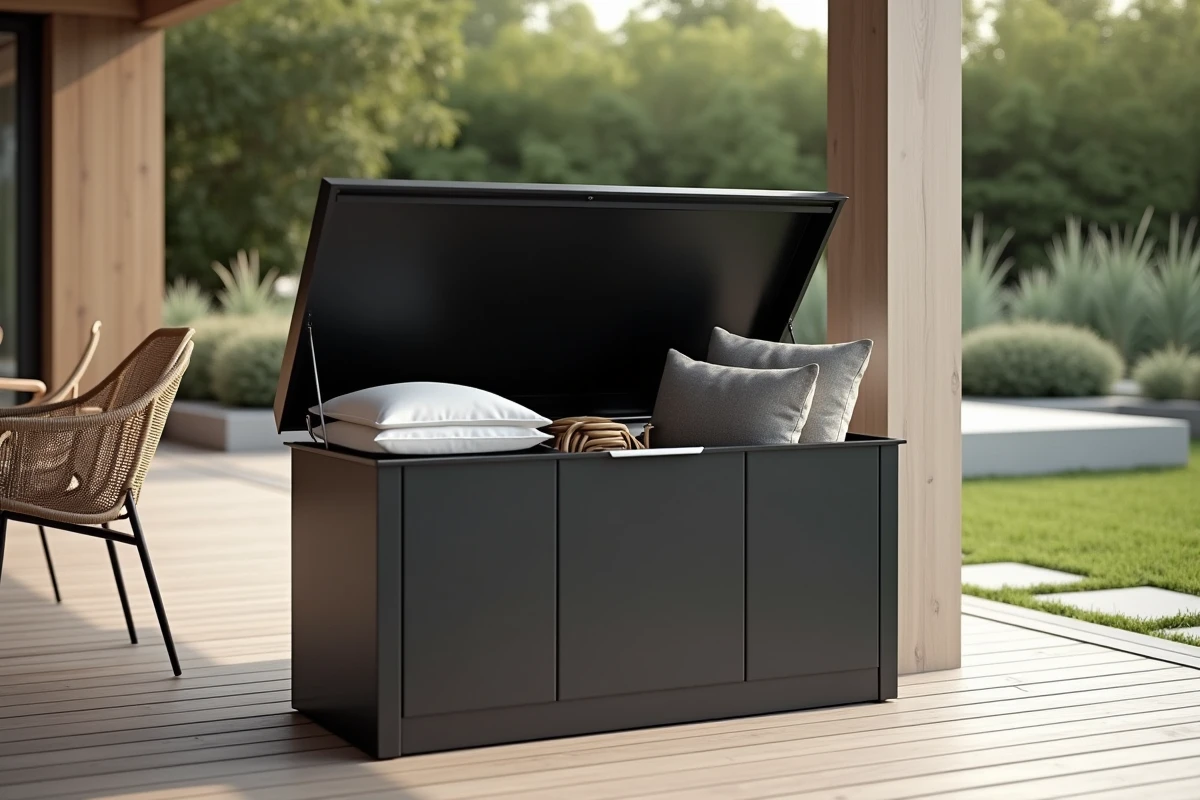
With the generalization of textile garden furniture (removable cushions, stretched fabrics), protection against weather and UV has become a key argument. Resins and hinges advertised as resistant to UV and corrosion meet a real need: a lounge cushion exposed to direct sunlight loses its colors and durability in just one season.
A waterproof chest, with a gasket lid and sufficiently thick walls, significantly extends the lifespan of these accessories. Models equipped with an integrated ventilation system also limit internal condensation, a detail that prevents mold on stored textiles.
- Check for the presence of a sealing gasket on the lid, not just a simple fitting
- Prefer stainless steel or composite resin hinges, which resist corrosion better than raw steel
- Ensure that the chest has low or side ventilation to prevent moisture buildup inside
Garden chest security: locking and stability
The question of security arises on two levels. The first concerns locking: a chest placed on an accessible terrace may attract envy, especially if it contains tools or small valuable equipment. Some models incorporate a padlock slot, but this feature is not standard on entry-level references.
The second level, less obvious, relates to the stability of the lid. A chest used as a bench by children can tip over if the lid is not equipped with a support strut. Models with hydraulic pistons allow for gradual opening and prevent the lid from falling suddenly, a point of caution for families.
- Check compatibility with a standard padlock if the security of the contents is a priority
- Test the lid opening system: pneumatic strut, simple hinge, or hydraulic pistons
- Check stability on the ground, especially on sloped terraces or uneven surfaces
Ground anchoring or mobility
Some large-capacity chests offer integrated wheels. This choice facilitates seasonal movement (bringing the chest closer to a pool in summer, storing it under a canopy in winter). However, a wheeled chest without brakes can move under the influence of wind on an exposed terrace. A fixed or ground-anchored model is better suited for windy areas.
The garden chest is no longer just a storage bin relegated to the back of the garden. Between compact formats for balconies, integrated seating functions, and increasing demands for outdoor textile protection, choosing a suitable model relies on precise technical criteria. Material, waterproofing, ventilation, locking: these four parameters determine long-term satisfaction far more than the advertised volume in liters.